Oracle2026-10-03 23:26:31Oracle and Paramount Credit Risk Start Trading as One as Larry Ellison Link Draws ScrutinyParamount Skydance Corp. has added $52 billion in debt this week to finance its deal for Warner Bros. Discovery Inc., putting fresh attention on its leverage profile. At the same time, Oracle’s long-term debt has climbed to more than $160 billion as the company spends heavily to build out artificial intelligence computing infrastructure, making it the fifth-largest issuer in the U.S. corporate bond market. The connection between the two companies is Larry Ellison. Wall Street investors are increasingly treating Paramount and Oracle as linked credit stories because Ellison’s family wealth, long seen as a potential backstop for Paramount, is heavily concentrated in Oracle stock. That assumption has come under pressure after Oracle shares fell more than 50% over the past year, free cash flow turned negative, and S&P Global Ratings cut both companies. According to Bloomberg, the cost of credit default swap protection on Paramount and Oracle has begun moving in closer alignment, suggesting fixed-income investors are pricing them as related risks. Investors and institutions cited in the report say credit analysis now needs to account for Ellison exposure across both companies, rather than viewing each issuer in isolation.60
Morgan Stanle2026-08-26 04:01:36Morgan Stanley says Nvidia’s AI financing expansion adds a new credit risk factorMorgan Stanley has initiated credit coverage on Nvidia and assigned it a neutral view, arguing that the company’s balance sheet and cash flow remain very strong but that its growing role in AI infrastructure financing is making its credit exposure harder to assess. The bank’s main focus is a shift in Nvidia’s position: beyond selling GPUs, it may increasingly help cloud providers and data center operators fund computing capacity through residual value guarantees, revenue-sharing arrangements, credit support, and co-financing structures. Morgan Stanley said this broader involvement ties Nvidia more closely to the financing mechanics behind large-scale AI buildouts. The bank estimates Nvidia’s broad credit exposure could approach $200 billion by the end of 2028, as the company takes part in an AI infrastructure financing platform valued at more than $500 billion. Morgan Stanley said that does not change Nvidia’s central place in AI hardware, but it could lead markets to reprice the company’s risk. With volatility in AI-related stocks rising, investors are already paying closer attention to returns on cloud capital spending, the timing of AI revenue realization, and financing pressure across data centers. If AI computing assets depreciate faster than expected, or if some customers generate less cash flow than market assumptions imply, Nvidia’s ecosystem financing arrangements could become a new variable in valuation.950
Sycamore Tree2026-08-25 19:57:54Sycamore Tree Capital warns AI infrastructure financing boom may create credit riskSycamore Tree Capital has warned that the current financing boom tied to artificial intelligence infrastructure buildouts may be creating credit risk. The investment management firm said the fallout could resemble the collapse of the telecom bubble, with possible damage to financial market stability and investor confidence. The item was published by Techub News and cited Crypto Briefing as the source. No additional figures or timelines were disclosed in the brief. The warning centers on the pace and scale of funding flowing into AI infrastructure, rather than on any single company or transaction. In the short note, Sycamore Tree Capital framed the concern as a broader market risk that could extend beyond the sector itself if financing conditions deteriorate.890
Michael Saylo2026-08-12 07:41:01Strategy's Bitcoin Credit Model Uses 10% ARR Case to Track Risk, Saylor SaysMichael Saylor said Strategy's bitcoin credit model uses a 10% bitcoin ARR (annualized return rate) case to track credit spreads and undercollateralization risk. The model is designed to assess credit risk exposure tied to bitcoin. Strategy, formerly MicroStrategy, is one of the largest corporate bitcoin holders, and the model's parameters reflect institutional-grade risk management standards. Cointelegraph reported.1670
AI data cente2026-08-10 18:33:13Wall Street Starts Pricing Community Backlash Into Data Center Credit RiskWall Street lenders backing the AI data center buildout are paying closer attention to community opposition where projects are planned, as protests and permitting disputes add a new layer of credit risk. Reuters reported Monday that banks and asset managers are increasingly factoring local resistance into financing decisions, on top of technical, environmental, zoning, insurance, and financial assessments already standard in project underwriting. Concerns raised by residents include electricity costs, water consumption, noise, and the physical scale of proposed facilities. Bank of America infrastructure finance head Karen Fang told Reuters that project readiness now includes both formal approvals and support from nearby communities. Data Center Watch said at least 75 data center projects worth about $130 billion faced local opposition in the first quarter of 2026. Goldman Sachs estimated last month that AI infrastructure spending would top $5 trillion by 2030. Organized resistance has also spread across the U.S., with nearly 40 arrests tied to protests this year, 142 demonstrations across 42 states in July, and at least 15 states considering construction moratoriums, according to a July Brookings report.1740
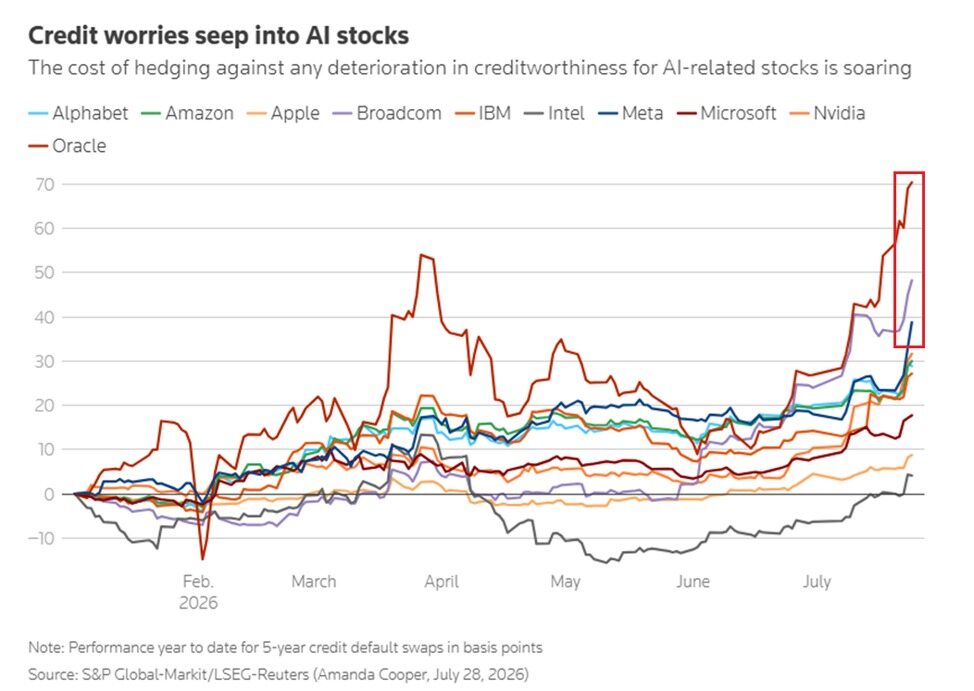
Oracle2026-08-09 00:08:39Oracle’s 5-year CDS jumps 70 bps this year as credit risk rises across Big TechCredit pressure is building across major technology companies, according to market research firm The Kobeissi Letter. In a post on X, the firm said investors are growing more concerned about Big Tech debt, with Oracle showing the sharpest move. Oracle’s 5-year credit default swap, or CDS, has risen 70 basis points year to date to roughly 215 basis points, a record level and the biggest increase among large-cap tech names mentioned in the update. Broadcom followed with a 48-basis-point rise over the same period. Meta’s 5-year CDS climbed 39 basis points to 95 basis points, its highest level since trading began in October 2025. Nvidia’s 5-year CDS rose 32 basis points in 2026 so far to about 82 basis points, the highest since trading started in November 2025. Amazon and Alphabet also posted gains of 30 and 29 basis points, respectively. At the same time, Big Tech companies have issued about $200 billion in corporate bonds so far this year, nearly double the full-year total seen in 2025. The Kobeissi Letter said credit markets are becoming increasingly concerned about the cost of financing the AI race.2710
Nvidia2026-07-28 15:45:09Nvidia 5-year CDS jumps as report points to massive AI infrastructure dealNvidia’s 5-year credit default swaps jumped after a report said the company is moving forward with a new AI infrastructure transaction valued at $750 billion. The move in CDS pricing points to rising market concern over Nvidia’s credit risk, with attention centered on the financial strain that could come with such a large capital spending plan. Nvidia has previously said it would invest heavily in AI infrastructure to maintain its lead in the market. The report was cited by Cointelegraph. While the price move does not by itself spell out a specific funding outcome, it shows investors are paying closer attention to the balance between Nvidia’s expansion plans and the financial burden that may come with them.2000
Nvidia2026-07-28 00:53:00Nvidia CDS Spread Hits 57.25 Basis Points as AI Debt Gets RepricedNvidia’s five-year credit default swap spread widened to 57.25 basis points, marking the biggest jump on record, as investors reassessed credit risk across the AI supply chain. The move came as hyperscale companies are expected to spend more than $750 billion on AI data centers in 2026, according to the report cited by CryptoBriefing. Nvidia is also planning to sell between $20 billion and $25 billion in highly rated bonds in mid-June. Reported demand reached $85 billion, leaving the deal about four times oversubscribed. The financing backdrop points to strong investor appetite for debt tied to AI infrastructure. Earlier, GPU cloud provider CoreWeave sold $4.59 billion in junk bonds. Taken together, the transactions show that capital markets are actively funding AI buildout even as credit protection costs rise for key names in the sector.2780